
BMW brakes by itself in the rain or when the wipers are on
Some BMW drivers experience a strange and sometimes frightening problem: the car suddenly seems to brake by itself when it rains or when the wipers are active. It feels as if someone briefly presses the brake pedal, while the driver is not braking.
In many cases there are no clear error messages on the dashboard. Even when the car is read out, there are sometimes no permanent fault codes. As a result, the cause is often wrongly sought in brake calipers, brake discs, ABS sensors or even driver assistance systems.
On certain BMW models, however, the cause can be the DSC/ABS module itself, more specifically in systems with an ATE MK100 ABS/DSC pump.
What is brake drying?
On certain models BMW uses a function that lightly prepares the brakes in wet weather. This function is often called “brake drying” or “brake disc drying”.
When the wipers are active, the system assumes there is rain or moisture on the road. The DSC/ABS module can then build up very light brake pressure so that the brake pads briefly touch the brake discs. The aim is to remove water from the brake discs so that the brakes respond faster and more consistently when the driver really has to brake.
Normally this function should be barely noticeable. It should certainly not cause the car to slow down clearly or jerk.
What goes wrong with this problem?
With a defect in the DSC/ABS module, the brake drying function can intervene too strongly. Instead of a light, almost imperceptible pressure on the brakes, the system builds up noticeable brake pressure.
The driver may then experience complaints such as:
- the BMW brakes by itself in the rain;
- the car briefly hesitates when the wipers are on;
- it feels as if someone is pressing the brake pedal;
- the problem occurs mainly in wet weather;
- there are often no clear fault codes;
- sometimes it seems to be felt mainly on one axle or at the rear.
This makes diagnosis difficult. Without knowledge of this function, the complaint seems to occur at random.
Which BMW models can have this problem?
This fault pattern is mainly linked to BMW models with an ATE MK100 ABS/DSC unit. In practice it can occur on certain versions of, among others:
- BMW 1 Series F20/F21;
- BMW 2 Series F22/F23/F45/F46;
- BMW 3 Series F30/F31/F34;
- BMW 4 Series F32/F33/F36;
- BMW X1 F48;
- BMW X2 F39;
- and other BMW models with similar DSC/ABS technology.
Not every car with such an ABS module gets this problem. So it is not a diagnosis you can just make without checking. But if the complaint is clearly related to rain or active wipers, the DSC/ABS module should definitely be examined as well.
Why is this dangerous?
A braking system is safety-critical. A car that noticeably slows down without a brake command can cause dangerous situations. Especially on the highway, in corners, on wet roads or when vehicles behind are following closely.
That is why we advise against continuing to drive with this problem. Even when no warning light is on, the complaint can be serious.
How do we make the diagnosis?
At BimmerStore we do not look only at fault codes. With this type of problem it is important to reproduce the complaint correctly and rule things out logically.
Depending on the situation we check, among other things:
- fault codes in DSC/ABS and other driver assistance systems;
- brake pressure values and plausibility;
- operation of the brake calipers;
- brake lines and hydraulic connections;
- ABS/DSC module for part number and compatibility;
- whether the complaint occurs with wipers/brake drying active;
- whether there are mechanical brake problems.
Only when the complaint and the diagnosis match do we recommend replacing or overhauling the DSC/ABS module.
Service history does not always tell the whole story
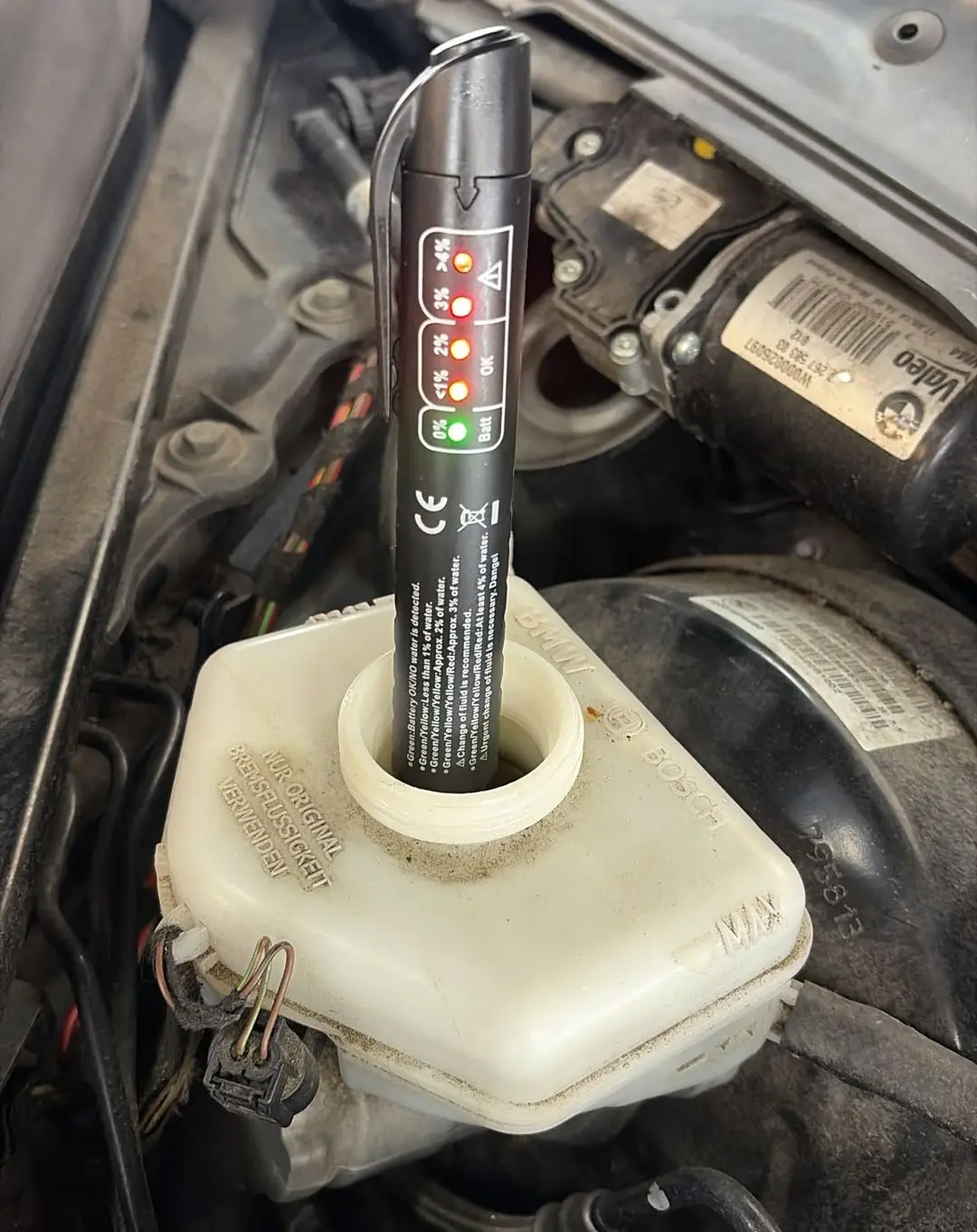
Something else stood out during this diagnosis: according to the service history the brake fluid had recently been registered as replaced, but on checking, the moisture content turned out to be clearly too high. That does not automatically mean there is malicious intent involved, but it does show that a digital service reset in itself is no guarantee that the brake fluid was actually and correctly changed. In practice we sometimes see that only the service indicator is reset, that only the reservoir is sucked empty, or that the system is not fully flushed through all brake calipers and the DSC/ABS circuit. Moist or contaminated brake fluid not only lowers the boiling point, but can also promote internal corrosion, contamination and valve problems in the ABS/DSC module. That is why, with brake and DSC problems, we do not just check the service history but also measure the actual condition of the brake fluid. That gives us a more honest picture of what is really going on technically.
Overhaul or used DSC/ABS module?
There are usually two realistic solutions.
1. Having the original DSC/ABS module overhauled
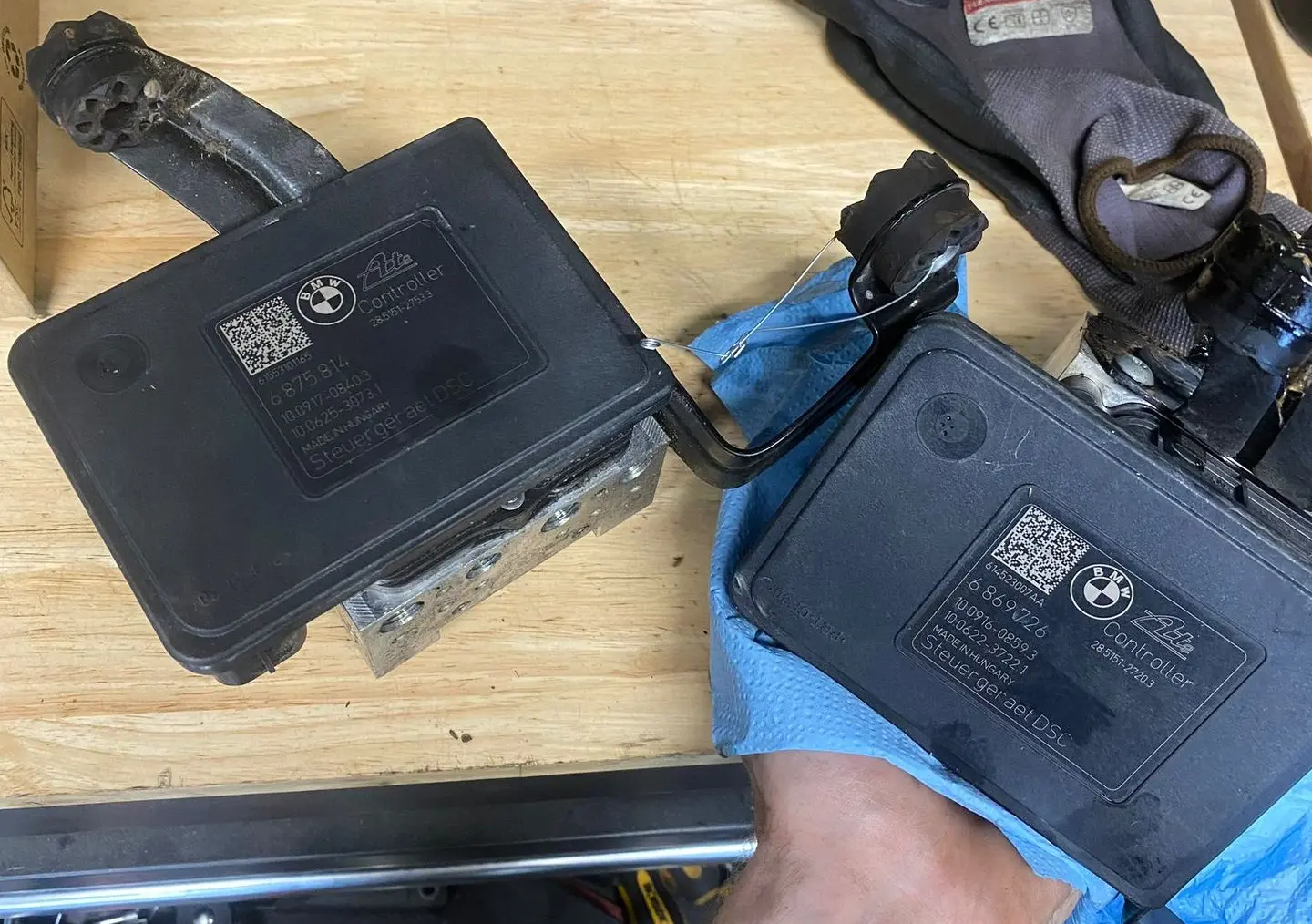
With an overhaul, the car's original module is retained. The advantage is that the module already belongs to the car and usually raises fewer programming or compatibility questions. A specialized overhaul company can tackle the known internal problem and test the module.
The disadvantage is that the car is usually off the road for a few days and that the module has to be removed, shipped and later refitted.
2. Fitting and coding a used DSC/ABS module
Another solution is to fit a correct used DSC/ABS module. It has to match the car exactly and then be correctly programmed or coded to the vehicle configuration.
The advantage is that this can be quicker when the right module is available. The disadvantage is that a used part always remains a used part. Its history is not always known.
With both solutions the brake system has to be correctly filled and bled. On BMW DSC/ABS systems this often requires a diagnostics-controlled bleeding procedure and the steering angle sensors have to be re-taught. And of course the new pump also has to be coded.
Our approach
At BimmerStore we look at what the best solution is for each vehicle. Sometimes overhauling the original module is the neatest choice. In other cases a correct used DSC/ABS module is economically more attractive or available sooner.
We take care of:
- correct diagnosis;
- removal and installation of the DSC/ABS module;
- checking brake lines and connections;
- filling and bleeding the brake system;
- coding/programming the DSC module if necessary;
- test drive and final check.
Do you recognize this problem?
Do you notice that your BMW brakes by itself in the rain or when the wipers are active? Then it is important not to ignore this. Even without an error message there can be a problem in the DSC/ABS system.
Contact BimmerStore for a targeted diagnosis of your BMW brake system.
BimmerStore is an independent BMW and MINI specialist in Herenthout (province of Antwerp, Belgium). We carry out repairs on BMW and MINI in our own workshop, by appointment.
BMW brakes by itself in rain or with the wipers on: DSC/ABS MK100 problem explained