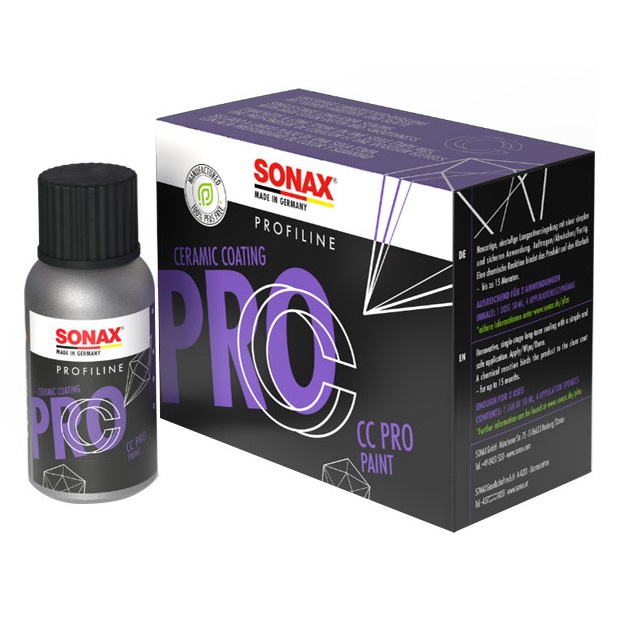
Sonax CC Pro is a ceramic coating from Sonax that only requires one coat to provide up to 4 years or 40,000 kilometers of protection. This coating is the professional version of CC One V2. The difference between CC One V2 and CC Pro is that CC One V2 is aimed more at consumers. It is extremely easy to apply and very forgiving. It has a durability of 3 years or 30,000 km and a curing time of 4 hours. The CC Pro requires a little more attention when applying, as it cures faster, meaning you will need to remove the excess product more quickly with a microfiber cloth. The CC Pro dries faster because it contains fewer thinners to make the coating easier to spread and simpler to use. This means that the concentration of protective ingredients is higher, resulting in longer durability, better performance, and a shorter curing time of just 2 hours!
The CC PRO is still easy to apply with the included sponge applicators, but it is thicker than the CC One V2. There is enough product and applicators to treat one large SUV or two smaller cars. You can apply multiple layers of CC PRO to the paint, but this will not double its lifespan. If you want to apply a second layer, we recommend allowing an hour and a half drying time between coatings. And although Sonax advertises a realistic 4 years of protection and 40,000 km, we would not be surprised if you get even longer protection from this product. Given the positive points and the price of this product, it is a real winner for us, and we use this coating ourselves in our workshop for our 3-year coating package.
To achieve the best performance and longest durability of the coating, it is important to give the paintwork a good pre-treatment. This involves washing the car thoroughly, removing iron particles and tar, giving it a clay treatment, and preferably also polishing the car. After that, it is necessary to degrease the paintwork with a surface degreaser such as Sonax Prepare.
Once the car is ready, open the product and apply 4-5 drops of Sonax CC PRO to the white side of the application sponge. This will allow you to treat an area of approximately 50x50cm. It is important to apply the product thinly to the surface in horizontal and vertical overlapping movements to ensure even distribution of the product. If the applicator sponge starts to harden, it is best to use a new applicator.
After applying the coating to the 50x50cm area, you can usually remove it immediately with a microfiber cloth, depending on the conditions in which you apply the coating, of course. We recommend a thick microfiber cloth without edges, such as the Sonax Coating Towel. After removing the coating with a microfiber cloth, we recommend taking a new microfiber cloth and going over the area again, extending 10 centimeters beyond the area to ensure that you have removed everything. Regularly take a new, clean microfiber cloth and throw away the old used microfiber cloths. The excess coating will harden in the microfiber cloth, creating small crystals that will damage the paintwork the next time the microfiber cloth is used.
After applying the coating, it is important to keep the car dry for the first 2 hours and not to use any chemicals. Because this coating dries so quickly, it is the perfect solution for detailers, whether they work in a garage or not. Because the coating only needs to dry for 2 hours, you can easily coat several cars per day, unlike traditional coatings, which need to dry for 12 hours and require you to coat your car before closing time so that it can cure overnight. It also ensures that mobile detailers can perfectly coat a car if they see that it will remain dry for another 2 hours. The sun's UV rays will also cause the coating to dry even faster than 2 hours, making this a go-to coating for detailers! Please note that the warmer the climate, the faster the coating will dry when you apply it. If you find that the coating is more difficult to remove, you may need to wipe it off more quickly.
The coating will continue to harden after the first 2 hours, but will already be resistant to water. However, to protect the coating during its most vulnerable period, it is recommended not to wash the car during the first week.

 Zelf installeren
 Laten installeren
 Garantie
 Display
 Achteras Ratio
 Drag Race Mode
 Launch Control
 Kickdown Launch
 Vertrekken in 2e
 Stilstaan in 2e
 Verhoogde druk