The advantages
Tax advantage - registration and annual road tax
A light commercial vehicle ("lichte vracht") has quite a few tax advantages, but let's start with the ones you get immediately once your car has been converted. Registering it as a light commercial vehicle is much cheaper than registering a passenger car, whether you do so as a natural person, a legal entity or a private individual. Depending on the engine size, CO2 emissions and Euro standard, this will be several hundred euros cheaper. There is no registration tax (BIV), and the annual road tax is often limited to just €35 or €200. As a private individual you can also register a light commercial vehicle and enjoy the reduced rate. You do not need a VAT number for this.
Tax advantage - VAT deduction on costs
A passenger car registered to the business is easily used for personal purposes too, so its tax advantages are often more limited than those of a light commercial vehicle. A light commercial vehicle registered to the business is assumed to be used mainly for professional purposes. To keep some control over this, however, a trip log has to be kept, recording each time whether the vehicle is used for professional or personal purposes. The resulting percentage of professional use is the percentage of VAT you can deduct on the costs.Because this is a rather cumbersome system, a flat-rate system can be used instead. This means you declare what percentage of the time you use the light commercial vehicle for professional purposes and what percentage for personal purposes. It is divided into 3 categories:
- 100% professional use. You may then use the light commercial vehicle only for professional purposes, and all related costs of using it are 100% deductible.
- 85% professional use. The light commercial vehicle is used mainly for professional purposes, with the occasional personal trip, for example to the shop.
- 35% professional use. The light commercial vehicle is used mainly for personal purposes, so you use it for professional purposes less than half of the time.
What does this distinction mean?
- You cannot combine the flat-rate system with a trip log system.
- It is mandatory to use either a trip log system or a flat-rate system. Because a flat-rate system is so much simpler, it is usually the one chosen.
- It is not suitable for light commercial vehicles that are used only very occasionally for professional purposes. As a consultant with an office job at various locations, who also uses the light commercial vehicle as a personal car and occasionally uses the extra load space to transport things for work, you can perfectly well use the 85% flat-rate system, even if you only use the car professionally. This is common among customers who have a large diesel engine in their touring. The reason it is calculated at 85% is that if only one car is registered to the business and it is a light commercial vehicle, an inspector will never believe that you use it for professional purposes only. In addition, they may then charge a benefit in kind during an audit.
Benefit in kind
When the light commercial vehicle is also used for personal purposes, a benefit in kind (VAA) is charged based on the share of personal use compared with professional use. It is calculated by dividing the number of private kilometers by the number of professional kilometers and multiplying by the sum of all professional costs for the use and maintenance of the vehicle.Having a light commercial vehicle converted, inspected and registered is no problem at all if you have an office job. Be aware, however, that this is monitored when you register a car as a light commercial vehicle. They will check your articles of association to see whether your business really needs one. If you work as a consultant for IT companies, for example, you may be audited and the tax advantage may not be granted.
Larger load space
When converting to a light commercial vehicle you lose the rear seats, but of course you gain a much larger load space. It extends from the boot all the way to the back of the front seats. This usually doubles your load space, so you can carry things much more easily, or perhaps even sleep in the back.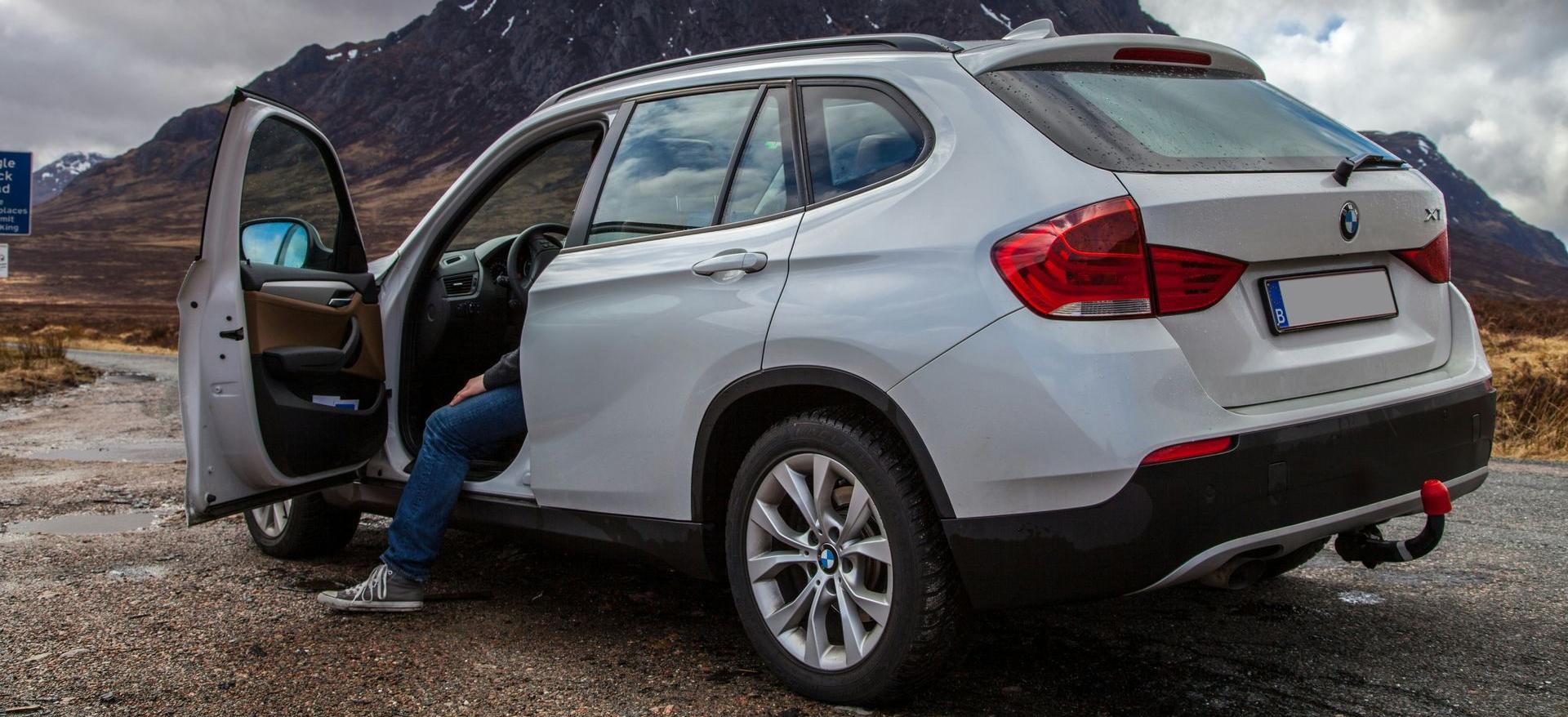
The requirements
SUV or touring
Light commercial conversions are only possible for tourings and SUVs. The law states that a coupé or saloon cannot be a light commercial vehicle, since it cannot consistently be used to transport goods. Many people used to take a saloon or coupé with a big engine and convert it to a light commercial vehicle to enjoy the tax advantage. This is no longer possible. Unfortunately the same applies to coupé SUVs such as the X4 and X6, as they are classified as coupés and not as SUVs.
VAT car
For a company to benefit fully from the tax advantages of a light commercial vehicle, the car must of course also be a VAT car. If you convert the car as a private individual, whether it is a VAT car or not, your only advantage is on the registration tax (BIV) and the annual road tax. Depending on the engine size, CO2 emissions and Euro standard, this can make a difference of several hundred euros per year. For the BIV and annual road tax there is no difference between a natural person and a legal entity.Legal requirements
- To qualify as a light commercial vehicle, the maximum permitted mass (MTM) of the car may not exceed 3,500 kg, which is never the case with a BMW.
- Only the 2 front seats may remain usable in a BMW.
- The load space of the car must be at least 50% of the length of the wheelbase. For example, the wheelbase of an X5 G05 is 2.98 m, so the load space must be at least 1.5 m long to meet this requirement. This can matter if you are tall and want to slide your seat all the way back.
- The load space must be separated from the passenger compartment by a partition at least 20 cm high. This partition may not be a net or similar, but must be firmly fixed, and it may not be easy to remove again. If it consists of 2 panels screwed together, the screws must be sealed with silicone, or you can cover the panels with a material such as fabric or rubber so that the screws are hidden.
- The floor of the load space must be made of solid material without extra anchor points for refitting seats or seat belts. This is to prevent people from quickly converting their light commercial vehicle back into a passenger car.
- The seat belts must be removed. The anchor points in the floor or seat base must be made unusable, for example with shear bolts. The anchor points in the side panels do not have to be made unusable.
- You must obtain a certificate from the manufacturer for the conversion to a light commercial vehicle. BMW, for example, works mainly with selected companies such as ours to issue these certificates, not with private individuals or companies that only do a one-off conversion.
The conversion
Removing the interior
To create a light commercial vehicle, the rear seat and seat belts have to be removed. It is often possible to remove the seat cushion and fold the backrest flat, so that the load space is level up to the distance required for a light commercial vehicle. In that case we give you the choice between a load floor panel on top of the seats, or having us remove the seats completely and build a structure for the load floor to rest on. The latter is of course the more expensive option.
You naturally get back the parts we remove. After the interior has been removed, it will not be possible to simply refit the seats and seat belts, so you cannot quickly put everything back before each inspection. Shear bolts that cannot simply be removed are fitted in the seat belt anchor points in the floor. Should you want to convert the car back into a passenger car for personal use once it has been written off, that is possible.
Software changes
Because certain components are removed, changes also have to be made in the software so that the car does not show fault messages. This can apply to airbags, seat belts, electrically folding rear seats, and so on.
Fitting the load bed
Once the interior has been removed and the software adapted, it is time to finish the load bed. It is mandatory to fit a kind of tray made of solid material, with a raised edge of at least 20 cm between the load space and the back of the front seats.
Obtaining the certificate
Once we have converted the car, we contact BMW to obtain the appropriate certificate stating that your car has been correctly converted to a light commercial version. You must always keep this certificate with the rest of your vehicle documents, and it will be checked at the inspection.
Inspection and registration
Homologation
After the conversion, the car first has to be re-homologated as a light commercial vehicle with all the right paperwork. The homologation and the inspection for the conversion are done together, so you do not have to go back for another inspection before you can register the car as a light commercial vehicle.
Inspection
When you buy a car that is less than 4 years old, you normally do not have to take it for inspection. For a light commercial vehicle this is different. Even if you buy a new car and convert it, you have to go to the inspection for light commercial vehicles immediately after registration. The same applies to a converted car older than 4 years: it will have to be inspected again as a light commercial vehicle so that it can be registered correctly. After that you will also have to go for the periodic inspection every year, regardless of age or mileage. The periodic inspection for a light commercial vehicle also costs slightly more than for a passenger car.Registration
Once your car has been inspected as a light commercial vehicle, you can register it as such at the improved tax rate.
What does it cost?
Conversion
To begin with, the interior has to be removed together with the mounting points for the seats and seat belts. Since no two cars are the same, it is difficult to put an exact price on this.
Software changes
The software changes required also vary from car to car. The fewer electronics in the car, the fewer changes are needed, and the older the car, the easier it is to change. With very recent cars, such as when the X7 first came out, this took several hours, because the car is full of electronics and no information was yet known about the codes in the modules, so they had to be rewritten entirely by hand.
Fitting the load bed
The price of the load bed again depends on the size of the car. As you would expect, a load bed for a 3 Series touring costs less than one for an X7. A fairly universal tray can be used, or we can make one completely to measure. Again, the price varies.Homologation and inspection
Fortunately, we can give a more concrete price for the homologation and the inspection. The homologation and inspection as a light commercial vehicle take place at the same time and by appointment. The cost of this inspection is usually around €400, depending on how smoothly the inspection staff work. This is optional and you can do it yourself if you prefer.
The total?
If we carry out all the work from start to finish, including the paperwork and the homologation but excluding the inspection, a light commercial conversion is available from €2,350. In some cases the whole process can be completed fairly quickly. This depends on the car, how quickly the certificate is obtained from BMW and the dates available at the inspection centre.